
admin

Doc Bee Cee Leadership Series Paper 1

Leadership Academy Insight Paper No. 1

Author: Dr Brighton ChirekaFounder and Medical Director, DOCBEECEE Leadership Academy Date: 12 March 2026 Suggested citationChireka B. Dare to Care: Reclaiming Leadership through Hunhu and Dare in African Health and Social Care. DOCBEECEE Leadership Academy Insight Paper No. 1. Dare to Care: Reclaiming Leadership through Hunhu and Dare in African Health and Social Care Why African leadership must be rooted in dignity, participation and fair belonging Executive summary Leadership in African health and social care is often taught in borrowed language. It is frequently presented through imported managerial concepts that may be useful in some respects, yet still feel detached from the lived moral worlds of the people expected to lead. This paper argues that African leadership, and Zimbabwean leadership in particular, does not need to remain conceptually homeless. We already possess deep moral and social resources for leadership in our own cultural traditions. Among the Shona, two of the richest are Hunhu and dare. Hunhu offers a moral foundation rooted in dignity, reciprocity, accountability, service and shared humanity. Dare offers a process of leadership grounded in hearing people, creating space for voice, reasoning together and making decisions in ways that are publicly recognisable as fair. As Van Breda argues, ubuntu is not just a cultural slogan but a serious African theory for practice. In a similar way, Jaure and colleagues show that dare is not merely a meeting place, but a participatory way of hearing, reasoning and deciding together. Read together, these concepts point towards a different kind of leadership: one that is not defined first by title, visibility or control, but by conduct, legitimacy, participation and the ability to protect dignity in community. This paper introduces Dare to Care as a leadership framework for African health and social care. It argues that leadership must be reclaimed not only from imported language, but also from narrow and uncritical readings of tradition. True leadership is not just about belonging, but about fair belonging. It is not just about preserving community, but about shaping communities in which dignity, justice and inclusion are visible. That is why this paper insists that African leadership must be relational, ethical, participatory and critically inclusive. The goal of this paper is not merely to offer a concept. It is to strengthen a movement. It is to help leaders, educators, coaches and institutions think differently about what leadership means, how it is taught, and how it is embodied in the everyday work of care. 1. Why this paper, and why now? There is a gap in the way leadership is being taught, discussed and practised in African health and social care. Leadership is constantly called for. We speak about leadership in quality improvement, in patient experience, in team culture, in safeguarding, in service redesign and in community trust. Yet when many people are trained in leadership, they are still introduced to it as though it arrives from somewhere else. The language is often polished, technical and imported. It may sound impressive, but it does not always feel rooted. That matters because leadership is not just a set of tools. Leadership is a moral and social activity. It shapes how power is used, how people are heard, how decisions are made and how dignity is protected. In health and social care, those questions are not theoretical. They are lived every day by patients, families, staff, students and communities. This is why this paper matters now. African health and social care needs leadership that is not only effective, but also recognisable, humane and culturally grounded. We need leadership language that speaks to our people without sounding foreign. We need frameworks that help us lead with both competence and moral depth. We need concepts that can be taught, embodied and used in real life. Among the Shona, we already have such resources. We have Hunhu, which teaches that our humanity is proved in how we treat one another. And we have dare, which reminds us that leadership is not simply about deciding for people, but about hearing people, gathering wisdom and making fairness visible. This paper is therefore an act of reclamation. It says that leadership in African health and social care should not remain conceptually dependent on language that was never designed with our realities at its centre. It should be able to grow from our own moral soil. Zimbabwe’s Constitution, together with Chigwata’s work on traditional leadership, reminds us that indigenous leadership is not merely historical memory; it still carries public meaning and social legitimacy in contemporary life. 2. The problem with borrowed leadership language Borrowed leadership language is not always wrong. It can be useful, and some of it offers helpful tools. The problem is deeper. The problem is that when leadership is framed only through imported categories, it can become detached from the ways people already understand dignity, legitimacy, wisdom, responsibility and communal life. In many African health and social care contexts, this creates a quiet tension. Leaders may be taught frameworks that speak fluently about strategy, performance, influence and systems, yet leave too little space for the deeper moral questions that communities often care about most: Can I trust this leader? Does this leader hear people? Does this leader act fairly? Does this leader protect dignity? Does this leader serve the people, or merely occupy office? The result is that leadership may become technically competent but emotionally thin, structurally organised but socially distant, visible in title but weak in moral authority. That is one of the reasons some leadership training inspires briefly but does not always transform culture. It can teach methods without fully addressing moral imagination. Johnson and colleagues, writing about Sub-Saharan Africa, and Phillipson and colleagues, reviewing healthcare leadership training more broadly, point to similar concerns: many programmes remain unclear in theory, weakly grounded in context and inconsistent in evaluation. This is not a call to reject everything external. It is a call to stop treating African ideas as though they can only decorate leadership, never define it. We do not need

Leadership Academy Insight Paper No. 1 Read More »

Cultivating The 10 Ds of Self Leadership 

Cultivate the 10 Ds of Self Leadership – Dream, Direct, Decisive, Delegate, Deliberate ,Determined, Disciplined, Dedicated, Diligent and Discovery. Embark on a journey to uncover your life purpose while developing decisive thinking and discipline that will help you stay focused towards achieving set goals with persistence despite challenges. Develop strengths while delegating tasks to others as well as being intentional in all actions taken require dedication to gain success. Dream: It is important to define a clear vision and purpose in order to stay focused and motivated on the desired outcome. By having a clear dream of what you want to accomplish, you will be able to keep yourself accountable and strive for excellence. Direct: Being able to direct your thoughts, emotions and behaviour can have a powerful impact on achieving your goals. Self-leadership requires the ability to stay in control of one’s mind and body in order to get the necessary things done with focus and clarity.  Decisive: Making decisions quickly is essential for successful self-leadership. Decisions made quickly often require less information than those that are delayed, allowing for more efficient action coming from leadership.  Delegate: A key part of self-leadership is understanding the strengths and weaknesses that you possess as an individual leader. This understanding allows for effective delegation of tasks, which frees up time for leadership roles that only you can fill. Valuing this time also helps reduce burnout by ensuring that tasks are handled efficiently.  Deliberate: Intentionality is one of the core aspects of self leadership; being intentional about one’s decisions helps them make better choices for themselves and for their team or organization. This allows leaders to be more mindful of the consequences resulting from their actions both now and in the future.  Determined: Despite any challenges, staying determined towards achieving goals is crucial when it comes to leading yourself effectively. Staying focused on the end result while taking consistent steps with persistence helps ensure success over time.  Disciplined: Taking action consistently in accordance with predetermined plans is necessary when it comes to self-leadership; discipline helps ensure that these actions are taken regularly and maintained over time in order to achieve desired outcomes.  Discovery: Self discovery enables leaders to understand who they truly are on a deeper level, recognise their strengths and weaknesses, and use those insights moving forward in life or work goals accordingly. Knowing oneself fully is an important part of becoming an effective leader who can contribute positively within an organization or community .  Diligent: Attentiveness towards details within goals can help ensure that nothing gets overlooked while moving forward with self-leading approaches; diligence serves as a reminder that attention needs to be paid even when goals appear daunting or difficult overall .  Dedication: Committing oneself fully towards achieving life purposes requires dedication not only towards goal achievement but also towards self-growth as well; developing oneself personally through consistent learning , reflection ,and growth oriented activities helps foster successful self-leadership practices . Conclusion  Leading yourself successfully comes down to following the 10 D’s:  Dream of your future, be Direct and Decisive in action, Delegate where you can, continually Deliberate what matters most to you; stay determined and Disciplined for success. Make sure that discovery is part of your journey too – knowing self better than anyone else does. And don’t forget diligence leads to Dedication for reaching goals!

Cultivating The 10 Ds of Self Leadership  Read More »

Women in Leadership in Healthcare: Achieving Gender Equity 

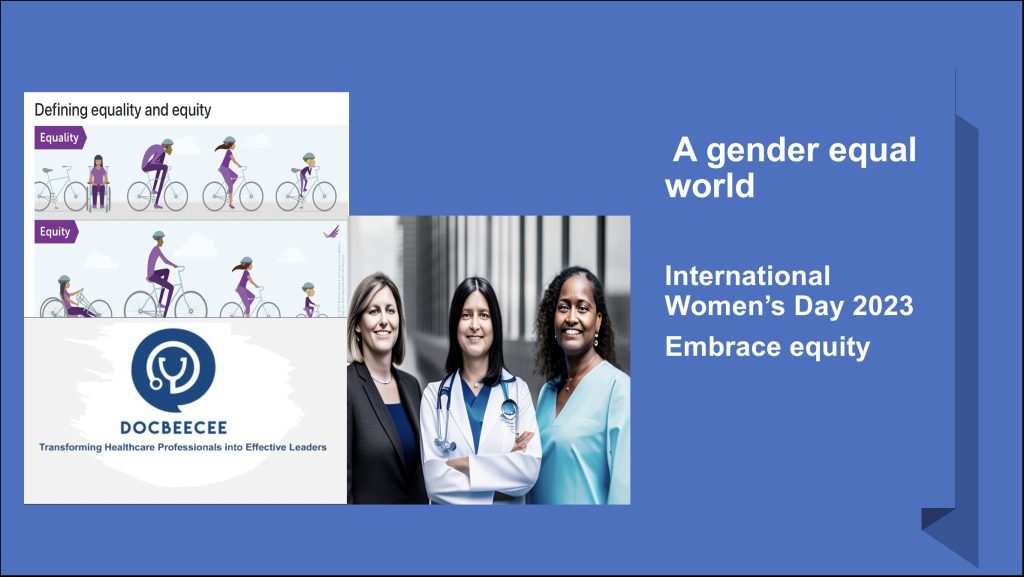
We’re living in a time where the gender gap is narrowing and women are increasingly taking leadership positions across various industries. However, in healthcare this isn’t always true; female physicians, nurses and other medical professionals oftentimes find themselves struggling to break through the proverbial “glass ceiling” that often plagues their profession. Women account for 70% of the global healthcare workforce, yet they make up only 25% of healthcare executives. International Women’s Day 2023 brings us #EmbraceEquity — an opportunity to come together to confront why equal opportunities can be exclusionary rather than inclusive, ultimately advocating for equity instead of equality.  This year’s theme — “Embrace Equity”— emphasises the need to move from equality to equity. At first glance, the words “equity” and “equality” may seem like synonyms; however, International Women’s Day 2023 sets to get us talking about why simply offering “equal opportunities” is no longer enough. Rooted in Latin terms for evenness or fairness – ‘aequus’ and aequalitas/aqualitas respectively – equity emphasises providing everyone with what they need to achieve success regardless of their circumstances whereas equality focuses on treating all people as if they had identical conditions. With that said, it’s equally important for us to recognise just how far we’ve come in making progress towards achieving real gender equity within the framework of healthcare. This blog post will discuss some key issues surrounding female leaders moving forward as well as outline potential solutions for attaining true equity. Why Gender Equity Matters in Healthcare  With advancements in the field of healthcare, it is now easier than ever to access vital treatment and care. Unfortunately, gender equity in healthcare still remains a major issue that imperils the health of our global population. In every nation there are inequalities based on gender, resulting in disparities when it comes to accessing quality healthcare and resources. This can result in a higher risk of long-term illnesses and mortality rates for those with more limited resources. As we approach International Women’s Day 2023 and reflect upon the #EmbraceEquity campaign, we need to focus on why gender equity matters within the healthcare system. Without equitable distribution of resources, access to quality care remains an obstacle for many; this is unacceptable from both an ethical and medical perspective. We must work together towards implementing systems that ensure every individual, regardless of their gender or available funds can receive the necessary support without stress or worry. The Current State of Women Leaders in Healthcare  Our world has come a long way since the inception of International Women’s Day over a hundred years ago, and especially in the healthcare sector. Despite making up a majority of the healthcare workforce, women still lag in leadership positions whether that is hospital administrators or faculty positions in medical schools. This 2023 IWD campaign seeks to not just bring attention to this glaring discrepancy but seek tangible ways to change these realities so that we can fully embrace equity in our healthcare institutions and beyond. In order to realize that goal, it is important to recognize existing systemic barriers such as unequal pay, gender-based discrimination, and unconscious bias that have prevented women from ascending leadership roles within healthcare organizations as well as our working culture at large.  #EmbraceEquity serves as an important starting point for us to finally make strides toward achieving true gender equality. Barriers to Female Leadership in the Industry  Despite our best efforts, female leadership in the industry is facing more and more barriers; data indicates that the global gender gap between men and women in leadership positions persists. Society must work together to fully understand why these discrepancies exist and actively strive to tear down the barriers faced by women in the workplace – be it discriminatory hiring practices, outdated stereotypes and norms, or unequal pay. Such conversations are at the heart of International Women’s Day 2023 campaign, #EmbraceEquity: sparking dialogue about how equal opportunities can actually uphold inequity rather than promote inclusion. We must go from this point towards increasing equity for all parties involved through tangible initiatives and actions in order to create truly equitable conditions for female leaders in all industries. How to Create Equal Opportunities for Women  To create equal opportunities for women around the world, it is essential to focus on creating equitable environments. This means that we should go beyond simply dismantling unjust practices and historical systems of oppression, and instead build new ideas, frameworks and approaches that promote resilience, resourcefulness and sustainability. We must also recognize that equity goes beyond just providing access to resources; it is about ensuring diverse voices are heard and represented in positions of power. As part of this effort, we must continue to celebrate International Women’s Day’s #EmbraceEquity campaign which seeks to spark global conversations about why equal opportunities can be exclusionary rather than inclusive and how we should pursue equity. Together we have the opportunity to bring real change by shifting our focus away from merely rectifying existing unfairness towards creating a future where all individuals—regardless of gender identity—have equal economic autonomy and security. Encouraging Mentorship and Role Modeling for Young Women  International Women’s Day is a platform to enter into critical conversations about how equity can help ensure that young women are provided with the resources, knowledge, and support they need to thrive in the 21st century. Our #EmbraceEquity campaign aims to foster an environment where young women are able to look up to role models who provide mentorship and guide them on their path towards success. It is imperative that we invest in young female leaders – becoming actively involved in mentoring them will inspire these brave ladies to persist, grow, and ultimately reach heights beyond their imaginations. Let us commit ourselves to showing our unwavering support of righting long-standing inequities in lifetime opportunity – thus we can begin confidently embracing equality on a global scale. Practical Strategies to Increase Female Representation in Healthcare Leadership Roles As we celebrate International Women’s Day 2023, it is time to make a conscious effort towards ensuring

Women in Leadership in Healthcare: Achieving Gender Equity  Read More »